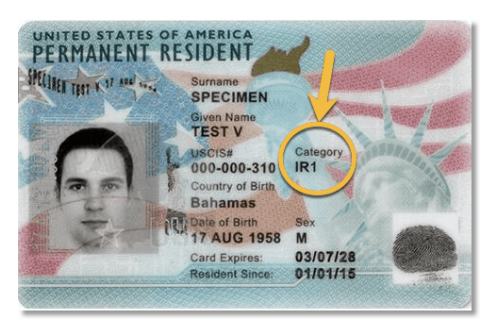
Green card category codes (also known as class of admission codes) are 3-character identifiers found on your Lawful Permanent Resident card. They indicate the exact immigration category—such as family-based, employment-based, or refugee/asylee status—under which you received your residency.
How to Find Your Code: The 3-character category code is typically located on the front of your permanent resident card, usually listed under the label “Category” or right next to your photo.
Family-Based: Family codes typically start with IR (Immediate Relative) or F (Family Preference). Codes ending in 1-5 mean the immigrant applied from abroad, while 6-9 indicate a status adjustment inside the U.S.:
IR-1 / IR-6: Spouse of a U.S. citizen
IR-2 / IR-7: Child of a U.S. citizen
IR-5 / IR-8: Parent of a U.S. citizen (applied abroad / adjustment)
F11 / F16: Unmarried son or daughter (over age 21) of a U.S. citizen
F21 / F26: Spouse of a Lawful Permanent Resident (LPR)
F24 / F27: Unmarried child (under age 21) of a Lawful Permanent Resident
Employment-Based: Employment codes generally start with E (Employment) and represent the five primary preference categories:
E11 / E12 / E14: EB-1 category for priority workers (persons of extraordinary ability, outstanding professors, or multinational executives)
E21: EB-2 category for professionals holding advanced degrees or individuals of exceptional ability
E31: EB-3 category for skilled workers and professionals
E32: EB-3 category for professionals with a U.S. baccalaureate degree or foreign equivalent
C51 / C56 / T51: EB-5 category for immigrant investors
Humanitarian & Special Programs:
AS6: Asylee adjusting status
DV1 / DV6: Diversity Visa lottery winners
RE6 / RE7: Refugee adjusting to permanent resident status
Conditional Permanent Residents: If your category code starts with a CR (Conditional Resident) or C (Conditional), your green card is subject to a 2-year expiration, after which you must file to remove conditions:
CR-1 / CR-6: Conditional spouse of a U.S. citizen
CR-2: Conditional child of a U.S. citizen
The U.S. Citizenship and Immigration Services (USCIS) class code may be stamped on an I-551, a passport, or any other correspondence USCIS gives an immigrant. The class codes listed below are those given to immigrants applying for Lawful Permanent Resident (LPR) status.
The alphabetical letter(s) in the class codes represent the latest revision of the various classes while the numerical figure reflects the order and relationship within the class.
Curr. Class Code
Section of law
Description
AM1
Amerasian. born in Vietnam.
AM2
Spouse/child of AM1 or AM6.
AM3
Mother, guardian or relative of AM1 or AM6.
AM6
AM1 adjustment to LPR.
AM7
AM2 adjustment to LPR.
AM8
AM3 adjustment to LPR.
AS1
208
Approved primary asylee.
AS2
Spouse of asylee.
AS3
Child of asylee.
AS6
AS1 adjustment to LPR.
AS7
AS2 adjustment to LPR.
AS8
AS3 adjustment to LPR.
C20
Child of unmarried son/daughter of LPR,,Adjustment (conditional).
C21
216(a)(1)
Spouse of LPR (conditional).
C22
216(a)(1)
Child of LPR (conditional).
C23
216(a)(1)
Child of C21 or C22 (conditional).
C24
216(a)(1)
Unmarried child of LPR (conditional).
C26
Spouse of LPR, adjustment (conditional).
C27
Child of LPR, adjustment (conditional).
C31
216(a)(1)
Married child of U.S. citizen (conditional).
C32
203(d)
Spouse of C31 (conditional).
C33
203(d)
Child of C31 (conditional).
C36
Married son/daughter of U.S. citizen, adjustment (conditional).
CH
Humanitairian parolee Cuba or Haiti.
CH6
Cuban/Haitian entrant adjustment to LPR.
CP
Cuban/ Haitian parolee processed at Guantanamo or other public interest parolee.
CR1
201(b)
Spouse of U.S. citizen (conditional).
CR2
201(b)
Child of U.S. citizen (conditional).
CU6
Cuban refugee adjusted under Cuban Adjustment Act.
CU7
Spouse or child of CU6 (not Cuban).
DV1
Diversity principal, new arrival.
DV2
Spouse of DV1 or DV6, new arrival.
DV3
Child of DV1 or DV6, new arrival.
DV6
Diversity principal, adjustment.
DV7
Spouse of DV1 or DV6, adjustment.
DV8
Child of DV1 or DV6, adjustment.
E11
203(b)(1)(A)
LPR with extraordinary ability.
E12
203(b)(1)(B)
LPR who is professor or researcher.
E14
203(d)
Spouse of E11 or E12.
E15
203(d)
Child of E11 or E12.
E21
203(b)(2)
LPR with advanced degree.
E22
203(d)
Spouse of E21.
E23
203(d)
Child of E21.
E31
203(b)(3)(A)(i)
Highly skilled LPR.
E32
203(b)(3)(A)(ii)
Professional with BA degree.
E34
203(d)
Spouse of LPR classified E31 or E32.
E35
203(d
Child of LPR classified E31 or E32.
F11
204(g)
Unmarried child of U.S. citizen.
F12
204(g)
Child of non-citizen classified F11.
F16
Unmarried son/daughter of U.S. citizen, adjustment.
F17
Child of F11 and F16.
F21
203(a)(2)
Spouse of LPR.
F22
203(a)(2)
Child of LPR.
F23
203(d)
Child of F21 or F22.
F24
203(a)(2)(b)
Unmarried child of LPR.
F26
Spouse of LPR, adjustment.
F27
Child of LPR, adjustment.
F31
203(a)(3)
Married child of U.S. citizen.
F32
203(d)
Spouse of F31.
F33
203(d)
Child of F31.
F36
Married son/daughter of U.S. citizen, adjustment.
F37
Spouse of married son/daughter of U.S. citizen, Adjustment.
Haitians Refugees admitted to U.S. on or after 6-1-94.
RE6
RE1 adjustment to LPR.
RE7
RE2 adjustment to LPR.
RE8
RE3 adjustment to LPR.
RE86
Refugee Parolee
S-13
American Indians born in Canada.
SY6
Syrian Asylee.
SY7
Spouse of Syrian Asylee.
SY8
Child of Syrian Asylee.
W16
LPR who was previously an LTR.
W26
LPR who was previously an LTR.
W36
LPR who was previously an LTR.
Y1-16, Y64
Refugees.
For more information on Green Card,
We would be happy to set a phone consultation with you using our self-service system where you choose your date and time for your phone consultation and upload your documents for the attorney to review.