
September 14, 2026: New York Attorney General Letitia James announced that a coalition of 22 states and the District of Columbia filed a federal lawsuit challenging the Department of Homeland Security’s (DHS) final “public charge” rule. Filed concurrently is a separate lawsuit from a coalition of major cities and counties led by New York City Mayor Zohran Mamdani. Attorney General James previously led a successful legal effort to stop implementation of an earlier version of the public charge rule during the first Trump administration.
July 20, 2026: DHS announced a final rule that rescinds the 2022 Biden-era public charge inadmissibility regulations. The final rule was formally published in the Federal Register on July 20, 2026, and goes into effect on Sept. 18, 2026. The updated guidance aligns with congressional intent that aliens in the United States be self-sufficient and not dependent on taxpayer-funded government benefits.
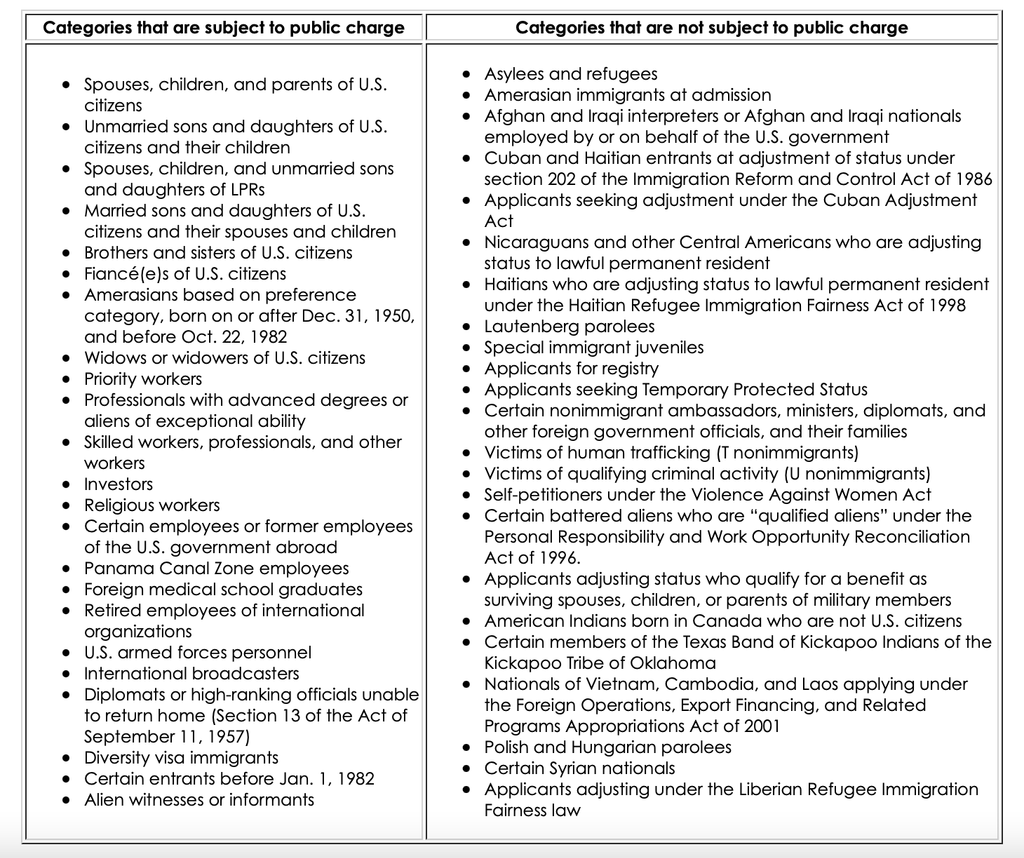
Aliens Subject to the Public Charge Ground of Inadmissibility
All aliens applying for adjustment of status to that of a lawful permanent resident are subject to the public charge ground of inadmissibility unless they are applying in an immigration category that is exempt. Below is a complete list of categories who are subject to and the categories that are exempt from the public charge ground of inadmissibility:
Making Public Charge Inadmissibility Determinations
While the Immigration and Nationality Act (INA) does not define public charge or likely at any time to become a public charge, Congress has specified that USCIS officers must consider five statutory factors when making public charge inadmissibility determinations. These five factors are an alien’s age; health; family status; assets, resources, and financial status; and education and skills. The INA also provides that USCIS officers may consider Form I-864, Affidavit of Support Under Section 213A of the INA, which is executed by an individual who agrees to use his or her financial resources to support the alien.
To make public charge inadmissibility determinations, USCIS officers will consider the five statutory factors and any other factor relevant to assessing the alien’s likelihood at any time of becoming a public charge, including the alien’s receipt of means-tested public benefits, such as cash assistance for income maintenance, housing assistance, food stamps, financial aid for college, or any other similar benefit. For means-tested public benefits received before Sept. 18, 2026, USCIS will only consider the alien’s receipt of public cash assistance for income maintenance and long-term institutionalization at the government’s expense. For means-tested public benefits received on or after Sept. 18, 2026, USCIS consider any and all benefits. USCIS will review all relevant evidence in an alien’s record and make case-by-case decisions in the totality of the alien’s circumstance.
Public Charge Bonds
If a USCIS officer finds that an alien applying for adjustment of status to that of a lawful permanent resident in the United States is inadmissible only because they are likely at any time to become a public charge, the USCIS officer may invite the alien to post a public charge bond. A public charge bond is a financial guarantee where individuals or companies pay a cash bond or post a surety bond with USCIS as an assurance that the alien will not become a public charge. If the alien posts a bond in compliance with the form instructions and the notice issued by the USCIS officer, the USCIS officer may approve the alien’s application for adjustment of status, which makes the alien a lawful permanent resident and allows him or her to remain in the United States.
To determine the public charge bond amount, the USCIS officer will consider how much government assistance the alien may be eligible for and potentially receive over the next five years.
If USCIS invites an alien to post a public charge bond, the alien may submit a cash bond or a surety bond (posted through a surety company certified by the U.S. Treasury) by submitting a Form I-945, Public Charge Bond.
Aliens may only submit Form I-945 if USCIS invites them to do so in a Notice of Intent to Deny. USCIS will not accept public charge bonds from aliens who did not receive an invitation from USCIS.
For more information on public charge,
We would be happy to set a phone consultation with you using our self-service system where you choose your date and time for your phone consultation and upload your documents for the attorney to review.
Click link to set phone consultation – https://gaillaw.as.me
text/call 407-292-7730 | whatsapp 407-353-1363 |email gail@gaillaw.com
Copyright © 2004-2026, Law Offices of Gail S. Seeram. All Rights Reserved.